Introduction.
The Apollo Mission is one of the most exciting chapters in human history. It’s the story of how humans set foot on the moon for the first time. Let’s dive into this incredible journey that made the impossible possible.
The Race to the Moon.
In the 1960s, the United States and the Soviet Union were in a fierce competition known as the Space Race. Both countries wanted to prove they were the best at space exploration. When President John F. Kennedy announced in 1961 that the U.S. would land a man on the moon by the end of the decade, it seemed like a bold promise. Little did anyone know; it would soon become a reality.
Building the Apollo Program.
Creating the Apollo program was no small task. Thousands of scientists, engineers, and astronauts worked tirelessly to design, build, and test the technology needed for the mission. The Saturn V rocket, which would carry the astronauts to the moon, was the most powerful rocket ever built. Every detail had to be perfect to ensure the safety and success of the mission.
The Apollo 11 Mission.
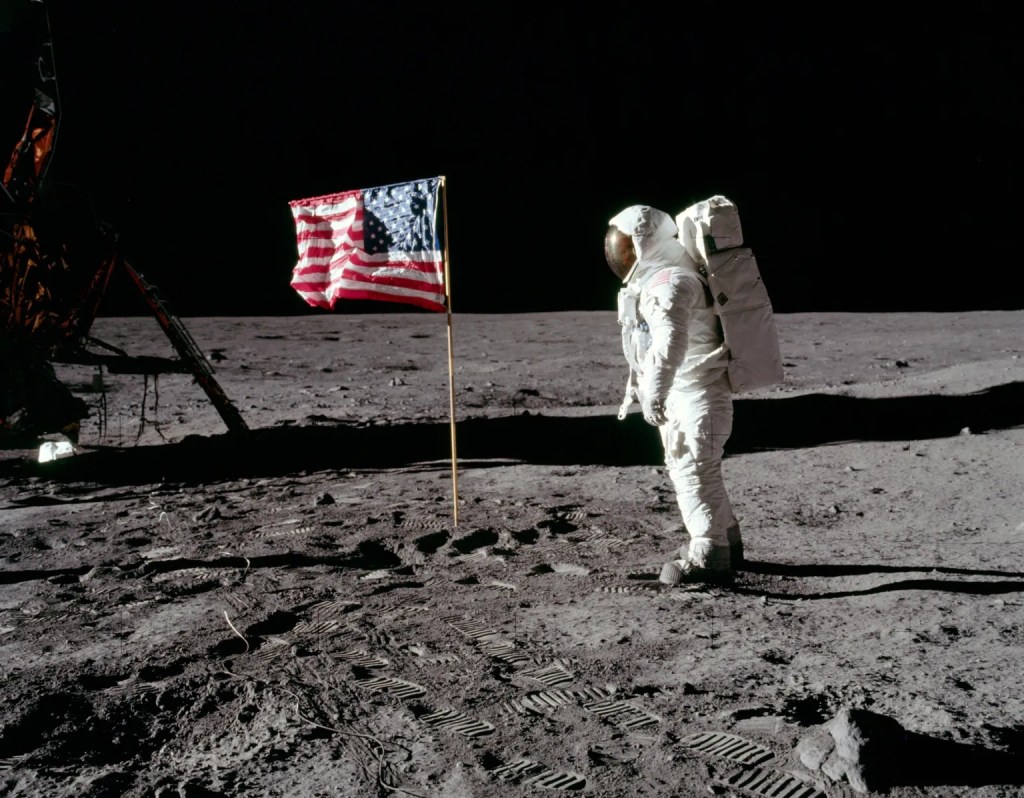
On July 16, 1969, the world watched as Apollo 11 launched from Kennedy Space Center in Florida. Astronauts Neil Armstrong, Buzz Aldrin, and Michael Collins were aboard. Four days later, on July 20, 1969, Neil Armstrong became the first human to walk on the moon. His famous words, “That’s one small step for man, one giant leap for mankind,” echoed around the globe. Buzz Aldrin soon joined him on the lunar surface, while Michael Collins orbited above in the command module.
Life on the Moon.
What was it like on the moon? The astronauts described it as a barren, dusty place with a grayish color. They collected rocks and soil samples, set up experiments, and planted the American flag. The moon’s low gravity made every movement feel like a slow-motion bounce. After spending about 21 hours on the lunar surface, Armstrong and Aldrin returned to the command module, and the journey back to Earth began.
The Legacy of Apollo.
The Apollo missions didn’t stop with Apollo 11. There were six more missions that aimed to explore different parts of the moon, conduct scientific experiments, and test new technologies. These missions taught us a great deal about the moon and space travel. The knowledge gained paved the way for future space exploration and inspired generations of scientists, engineers, and dreamers.
Why the Apollo Mission Matters.
The Apollo Mission was more than just a trip to the moon. It showed us that with determination, innovation, and teamwork, we can achieve the extraordinary. It expanded our understanding of space and our place in the universe. It also demonstrated the power of human curiosity and the desire to explore the unknown.
What’s Next?
The spirit of the Apollo Mission lives on today. NASA and other space agencies around the world are planning new missions to the moon and beyond. The Artemis program aims to return humans to the moon, including the first woman and next man. Private companies like SpaceX are also playing a big role in space exploration, making it an exciting time for space enthusiasts.
Conclusion.
The Apollo Mission was a monumental achievement that captured the world’s imagination. It reminds us that no dream is too big, and no challenge is too great. As we look to the future of space exploration, we can be inspired by the legacy of Apollo and the endless possibilities that lie ahead.
Are you curious about what it takes to explore the final frontier? Stay tuned for more exciting stories and updates on the latest in space exploration!












 Not Rocket Science!
Leave a comment