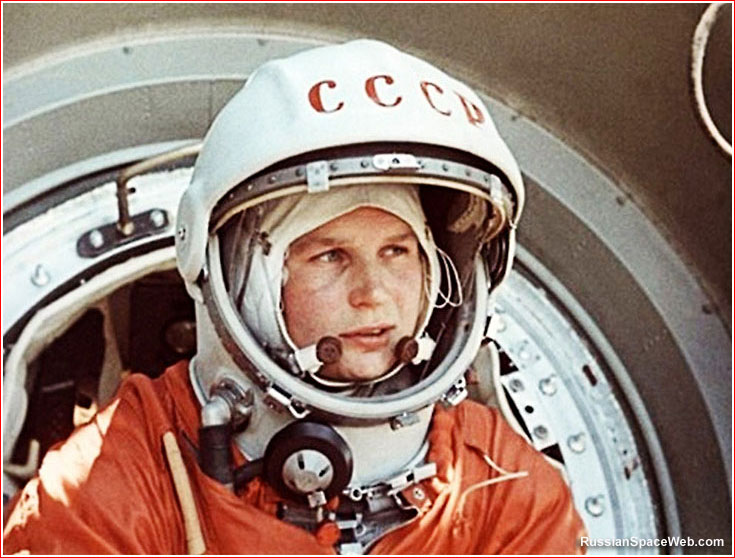
Sixty-one years ago on this day, 16th June 1963, a 26-year-old Russian female was getting ready to etch her name in the history of not only Russia but the entire world.
We are bringing this article in the honor of Russian Cosmonaut Valentina Tereshkova, who holds the title of being the first female to orbit earth in the space on a solo mission.1
Role of Space Race.
In 1962, General Nikolai Kamanin, head of cosmonaut training at USSR, visited John Glen, the first astronaut from America, in the USA accompanying the second USSR cosmonaut Gherman Titov.
In the meeting, Glen confirmed that 13 women astronaut candidates were recruited in 1960 for women in space program, two years earlier and almost three times the size of the group training in the USSR.2
It was Kamanin’s determination that women would inevitably fly in space one day, in which case the first of them ought to be a citizen of the USSR. Who knew that despite numerous hurdles from the higher ranks looking down at women space program as merely a distraction, Kamanin was going to make this herculean mission a reality very soon.
Tereshkova: The Perfect Candidate.
Over 400 applicants were invited for the screening, out of which only five were to be finalized, one of them was a 26-year-old woman from a small village on the Volga River. Her father was a former tractor driver who died in the Finnish Winter War serving the nation when Tereshkova was two. After her father’s death, her mother moved the family, seeking better employment opportunity, and became employed at a cotton mill.
At the age of 16, she began working at a textile mill, but continued her education. Tereshkova also became interested from a young age in parachuting and trained in skydiving at the local Aeroclub. It was her personal history which reflected Soviet values: the union of rural and urban life, sacrifices during WWII, and the parachuting experience making her a compelling choice for the program.
D-Day.
After the launch of Vostok-5 on 14th June 1963 piloted by Valery Bykovsky, attempting to complete longest flight mission till date, Tereshkova’s Vostok-6, the final Vostok flight, was planned to fly alongside Vostok-5 and eventually land together on 19th June 1963. After the successful launch, Chaika (Tereshkova’s call sign for this flight; meaning Seagull) radioed down,
It is I, Seagull! Everything is fine. I see the horizon; it’s a sky blue with a dark strip. How beautiful the Earth is … everything is going well.
Her mission was used to continue the medical studies on humans in spaceflight and offered data about the effects of space travel on women. Although it was found that she had not followed the protocol upon landing on to the earth when her doctor investigated the matter. 3
Regardless, Tereshkova became the first woman to go in the space that too on a solo mission orbiting earth for 48 times, attempting manual maneuver corrections and returning to the earth with 72 hours of space flight under her belt!4
Aftermath.
After returning to the earth three days after launch, Tereshkova took the podium at Red Square on 22nd June 1963 along with Yuri Gagarin (the first man to go into space piloting Vostok-1) and Pavel Popovich (the fourth man to go into space piloting Vostok-4), where she said the following referring to the anniversary of the German invasion of Russia that began 22 years ago that day,
Every person in this land knows what war is – it means grief and tears for millions. We don’t want war. Soviet people are busy with peaceful, creative work.
Two days after the celebrations on Red Square, Tereshkova was stepping onto another podium as guest of honor at the World Congress of Women on its opening day in Moscow. Declaring the need to protect Planet Earth’s beauty from the madness of war, she said,
I looked at our wonderful Earth and thought, ‘we must not let this shining blue planet be covered in black atomic dust’. And as I flew on, I thought how good it would be if my Vostok 6, this ‘female’ space craft, could make an invisible but powerful bridge between the hearts of all the women on Earth5
And hereafter marks her journey to become a leading politician narrating the above theme over and over again. On the other hand, despite of her willingness, she was not able to go into the space again, referring to the death of Yuri Gagarin in a routine training flight on MiG-15 and quoting that the USSR was not ready lose another hero.6
Conclusion.
The story of Tereshkova is indeed an outcome of the space race between USSR and US trying to get as many “firsts” possible and an attempt to demonstrate gender equality by USSR, but the weight Tereshkova holds in making this, a “successful” mission, is remarkable.
And one should note that despite of Vostok-6-onboarded-Tereshkova’s extraordinary achievement, it was still 19 more years for another female to go into space! And this is called being ahead of the time.
Reference.
- Pioneering Women in Space: A Gallery of Astronaut Firsts. Space.com. (Accessed: 15 June 2024). ↩︎
- Bridger, Sue. Women in the Khrushchev Era. “The Cold War and the Cosmos: Valentina Tereshkova and the First Woman’s Space Flight”. Palgrave Macmillan, 2004, p. 226. ↩︎
- Zak, Anatoly. Valentina Tereshkova Lands Successfully Aboard Vostok-6. RussianSpaceWeb.com. Last updated 6 March 2019. (Accessed: 15 June 2024). ↩︎
- Zak, Anatoly. Origin of the Vostok Spacecraft. RussianSpaceWeb.com. Last updated 25 March 2021. (Accessed: 15 June 2024). ↩︎
- Bridger, Sue. Women in the Khrushchev Era. “The Cold War and the Cosmos: Valentina Tereshkova and the First Woman’s Space Flight”. Palgrave Macmillan, 2004, p. 230 ↩︎
- Pearlman, Robert Z. Details in Death of Yuri Gagarin, 1st Man in Space, Revealed 45 Years Later. Space.com. 18 June 2013. (Accessed: 15 June 2024) ↩︎
TL;DR.
Generated using AI.
- Historical Event: On June 16, 1963, Valentina Tereshkova became the first woman to orbit Earth, marking a significant achievement in space exploration
- Space Race: The USSR aimed to surpass the USA, which had already recruited 13 female astronaut candidates by 1960
- Selection Process: Tereshkova was chosen from over 400 applicants due to her background reflecting Soviet values and her parachuting experience
- Mission Details: After the launch of Vostok-5, Tereshkova’s Vostok-6 launched and orbited Earth 48 times in 72 hours, providing valuable data on the effects of space travel on women
- Post-Flight: Tereshkova became a celebrated figure, speaking at Red Square and the World Congress of Women, promoting peace and the protection of Earth
- Legacy: Despite her success, Tereshkova never flew in space again. Her mission was a milestone in demonstrating gender equality but took 19 years before another woman flew into space






 Not Rocket Science!
Leave a comment