To think, to reason makes us human and sets us apart from the rest of nature.
People communicate in intricate ways about complex subjects and at the center of it all of the thinking machine, the computer, with it our thoughts can be recorded what once seemed impossible now seems commonplace. Today computers are capable of amazing tasks that boggle the mind but the evolution of a thinking machine, a computer, engaged some of the greatest minds of the last two centuries.
The story of the computer contains squandered chances, fortunate accidents, frequent missteps, fantastic insights, and unprecedented genius. It is the story of a machine that helps us win a war, figures in the creation of weapons of inconceivable destruction and sends us into space the birth of the computer spawned the growth of whole industries led to the world’s greatest personal fortune and will increasingly affect the lives of everyone on earth.
The building blocks for a computer.
Our world is increasingly filled with countless wonder that would not have been possible without one machine the computer. Although computers are enormously intricate, their most basic components consist of simple devices that can be switched to either one of two states, i.e. on or off. The computer creates its magic by calculating with a speed and accuracy that far surpasses its human inventors. Computers stagger the mind with their complexity, but simply put a computer takes information, processes it and then outputs a result. It’s all done with a unique partnership of hardware and software. Hardware comes in boxes, the physical components such as the monitor, the solid state drive etc. Software is stored in memory. Software consists of instructions that tell the computer what to do. One way to start this computational partnership is to type on the keyboard providing input, the input is picked up by the central processing unit or CPU, the computers brain, and using instructions provided by software, the CPU processes the input. The magic behind the CPU is its blinding speed, modern processors are measured in MIPs millions of instructions per second
While processing, the CPU may retrieve data stored in random access memory known as RAM or data stored on a solid state drive(SSD) or a Hard drive(HDD). Modern RAM is so quick that every second it can send the equivalent of 10,000 typewritten pages of information to the CPU and modern hard drives can store the equivalent of 250,000 pages of typewritten material. After processing the CPU outputs information often on a monitor the whole procedure is usually so quick but it appears instantaneous today computers are so commonplace we take them for granted.
But not long ago computers only existed in the imagination of a few visionaries. The search for machines that could figure quickly and accurately has seized the human imagination for thousands of years, in fact the computers family tree has roots so deep in the past it’s impossible to know exactly where they begin. By the early 19th century the European Industrial Revolution was well underway and the development in production and commerce came from the maturing fields of engineering, navigation, surveying, finance, and science The practical application of these fields relied on volume after volume of tables, tables for trigonometry, tides, interest rates, multiplication and gravity. Tables were critical, the actual figuring was done by people who specialized in mathematical computation. Surprisingly these people had a familiar job title they were called computers(lol). These human computers toiled over their tables incessantly, monotonously and made mistakes. Typically tables were full of errors the requirement for accurate tables introduced one of the most eccentric and brilliant figures.
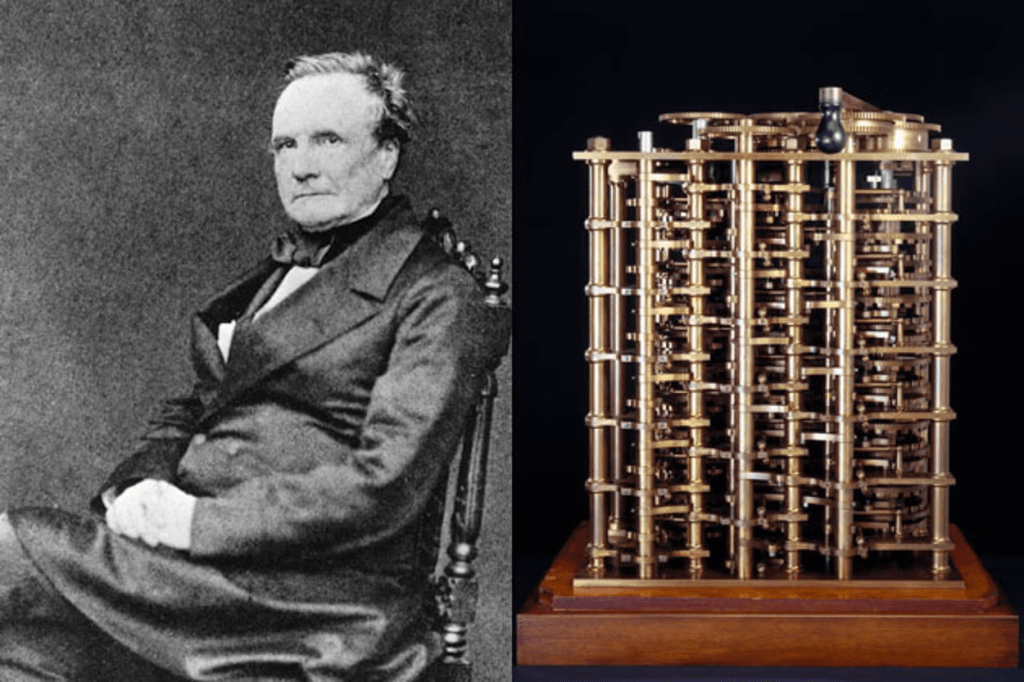
Enters Charles Babbage. Into the story of computers Charles Babbage, Babbage was an extraordinary scientist, I mean Babbage was a great scientist. Babbage was a hundred years ahead of his time, you can’t say that about many people(No, not even Einstein), but you could say that about Babbage. Charles Babbage represented that extraordinary element of British society, the scientist aristocrat, many were known for their eccentricities and Babbage was no exception. As a youth Babbage devised footwear of hinged boards intended to allow him to walk on water. Never one to shirk adventure, he tried them out himself but flipped over and nearly drowned. Babbage demonstrated his brilliance in mathematics. While attending Trinity College in Cambridge in 1820, Babbage was checking the accuracy of calculations made for the Royal Astronomical Society and kept finding errors he reasoned that a machine could be constructed that would calculate the tables and directly print the results he called the Machine. The difference engine he drew up plans for a section of the device and had it built with his own funds in 1822.
Babbage couldn’t pay for the construction of the entire device. But since the greatest beneficiaries would be the British government and people, he made the extraordinary step of petitioning the government for a grant. In 1823 the Treasury provided the project with start-up funds, government support for the computer industry is nothing new, it’s very much a big topic in the in the news today and it will continue to be. Computing is an expensive proposition and it usually requires some government support if it’s going to get
anywhere. Babbage hired a mechanical engineer set to work on a complete design for the difference engine and immediately ran into difficulties, the mechanical machine shops of the time were not advanced enough to produce parts and the precise measurements that Babbage’s plans required so Babbage designed better machine tools which would eventually improve the entire state of British tool manufacturing by 1829(What did I say about being ahead of time?). Babbage had spent the 1500 pound grant from the government and even more than that from his own funds but only a few bits and pieces of machine had been completed. Babbage’s project began to attract critics. He was plagued by several problems, one of his problems being his perfectionism, another problem being that his work was not understood or appreciated by the people of his time. Babbage had many enemies even London’s organ-grinder’s despised him because he had tried to have them banned as their music interfered with his thinking. But the inventor continued to toil and finally in 1832 there were enough parts to assemble a section of the engine. It functioned perfectly solving equations in producing six digit results but it was only a small part of the proposed machine, the skyrocketing costs and lack of results finally made the government pull its support from the project. Although disappointed by the cancellation, Babbage had contributed to the project’s demise by suggesting that a new device he had conceived the analytical engine would be vastly superior to his old design. Babbage in hindsight probably should have finished the difference engine and seen how far he could have gone with that before starting the analytical engine. There’s no question that the analytical engine was more than he could handle, Babbage was obsessed with his new idea with the analytical engine. Babbage asked himself why not build a machine that could solve any mathematical problem. At the age of 43, Babbage had the vision of a computer, a vision he pursued for the rest of his life, the extraordinary fact is that Babbage’s overall design for the analytical engine had many components analogous to those in a modern computer, the heart of the machine, the mill made the calculations like the central processing unit of modern computers, an oblong structure the store held numbers to be used in the calculations like modern computer memory instructions and numbers could be fed into the machine using punch cards.

Much of what we know about the workings of the analytical engine came from the writings of Ada, a Countess of Lovelace. Among the people who understood what Babbage was doing was a woman named Ada Augusta who was the daughter of one of the daughters of Lord Byron, the poet. She had studied mathematics as a child and had quite a bit of talent. Ada met Babbage at one of his famous dinner parties that were often attended by the luminaries of British science and engineering. Babbage demonstrated the working section of the difference engine for her and she was immediately captivated by it she published a simple description of Babbage’s vision for the analytical engine. Ada wrote some descriptions of it and she also appended to these descriptions a hypothetical way that this machine could solve an equation and on the basis of those descriptions people often call her the world’s first programmer. But she was never to program a real machine as Babbage entered the last years of his life, his great work was unfinished he had become cranky and suffered constant attack by his many enemies. In 1871 when London’s organ grinders discovered that Babbage was ill they surrounded his house and serenaded him increasing his agony until he died. Only a small portion of the analytical engine was built in Babbage’s lifetime, Babbage’s vision of the computer fell into obscurity and except for the detailed text left by Ada could well have been forgotten. Babbage’s machines which were never finished which existed for the most part only on paper were proto computers, they were mechanical they used gears, they used metal shafts, they weren’t computers in our sense of the term, that is they weren’t electronic digital computers but they were abstractly and on paper mechanical computers it would be nearly 100 years before a programmable computation device would again be conceived in the late 1800s.









 Not Rocket Science!
Leave a comment