ENIAC was complete a few months after the Japanese surrendered. Although it wasn’t finished in time to help win the war ENIAC was a marvelous machine, huge and how it could perform up to 5,000 additions 357 multiplications and 38 divisions every second by far and away the most complex machine of its time. ENIAC still lacked many of the qualities of a modern computer it’s memory was very primitive it had to be laborious, Lee rewired each time it was programmed and couldn’t make logical decisions based on its calculations. But with tremendous expenditures of time and money, ENIAC had proved that computers could be constructed. However except for arcane scientific calculation did anyone really want them? The question lingered could anyone build a really practical computer. Just before the end of the Second World War an advisor to the ENIAC project john von neumann wrote a paper that was to greatly affect the next stage of computer design, von Neumann possessed a photographic memory, an incomparably fast mind and was one of the principal scientists involved in the Manhattan Project.
The building of the atomic bomb he was also an advisor on ENIAC, the paper von Neumann wrote after the war delineated, the structure of a modern computer. The paper drew heavily on the work building the ENIAC, yet was undeniably augmented by Von Neumanns brilliance, von Norman’s computer was to have a processing unit, a controlling unit memory, input and output but most importantly in the evolution of computers it would hold its programming internally in its memory.
Internally held programs give computers their power and versatility because an internal program can modify what it does based on data or the results of computations in machines. Like the ENIAC programming had been hardwired or fixed so the machine was much less adaptable. The idea for storing the program internally was the last key to developing the true computer but whether it was von neumann’s idea has long been hotly debated Eckert and Mauchly claimed they formulated internal programs as a natural part of their work building ENIAC. Although they couldn’t stop and incorporate the idea into the machine but many who read the paper assumed that all the genius behind it was from the great von neumann.
He was one of the most widely regarded mathematicians in the world Eckert and Lee were relatively obscure Eckert was a young man just out of school, Lee had been a professor at a fairly out-of-the-way College they didn’t have international reputation. Eckert and Lee weren’t included as authors in the paper they felt they had been betrayed.
The most important effect of von neumann’s paper was to spur computer development, Eckerd and Lee moved into offices in Philadelphia hired a staff and set up a company that would build a business computer they called it the UNIVAC, they signed a fixed cost contract to build a UNIVAC for the Census Bureau, rolled up their sleeves and went to work. Unfortunately building UNIVAC turned out to be a monumental undertaking as they struggled to make UNIVAC real, they also struggled financially and needed to be bailed out by a series of larger companies.
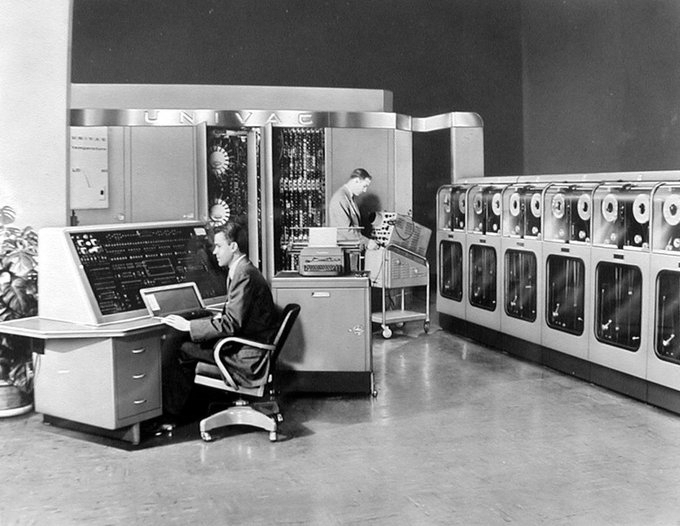
They eventually joined forces with Remington Rand, a flourishing typewriter manufacturer, in March of 1951 after six years of toil they finally delivered the first UNIVAC to the Census Bureau and unlike ENIAC the UNIVAC was an entire computer system designed for business. UNIVAC could be programmed for a variety of data processing tasks compact tape drives held data and results were automatically printed but even with the backing of Remington Rand sales remained slow, very few people understood how useful a computer could be.
That perception changed dramatically one night in 1952 in a brilliant public relations move Remington Rand arranged with CBS to use a UNIVAC on election night to predict the outcome of the presidential race between Dwight Eisenhower and Adlai Stevenson. Polls said the race was too close to call, no one had ever programmed a computer to make electoral predictions Eckerd and Lee’s engineers entered their customized algorithms right until air time the operators fed in the results of selected eastern precincts and at 9 p.m. ran their program. UNIVAC predicted a landslide for Eisenhower but the polls said differently, the operators didn’t believe what UNIVAC was telling them and assumed their programming was at fault, quickly they reprogrammed the machine to better reflect what the experts predicted as the night went on it became clear that Eisenhower would indeed win by a landslide. CBS sheepishly announced that they hadn’t believed the machines when all the votes were tallied UNIVAC initial prediction was off by less than 1% of the final result.
An extraordinary prediction even by today’s standards, the power and utility of the computer had been proved after the success of UNIVAC various companies began to see a future in computer development new companies like Burroughs as well as old giants like General Electric jumped into the computer business. But most large American businesses were dependent on the data processing systems provided by one company, the office machine monolith IBM.










 Not Rocket Science!
Leave a comment