Apollo 13 intended as the third lunar landing had just lost two fuel cells and was venting oxygen into space 200,000 miles from Earth, soon the second oxygen tank would begin losing pressure the astronauts would die unless they could precisely align their spacecraft and fire their rocket to slingshot themselves around the moon and back to earth critical to the alignment was Apollo state-of-the-art guidance computer. A new trajectory was figured the all-or-nothing rocket firing was made. The Apollo 13 crew miraculously returned to Earth with the help of their small and powerful computer by the last Apollo mission. 2.5 years later computers as powerful as those on Apollo would be available to everyone that was because soon before the Apollo 13 flight an engineer at Intel Ted Hoff had come up with an ingenious idea, Hoff had been told to design 12 separate integrated circuits to make a Japanese pocket calculator he suggested placing the entire processing unit on a chip and programming it just like a computer. Intel developed the idea and by 1970 they had a working model of a microprocessor.
It was the invention not just of integrated circuits but of a particular kind of integrated circuit, the microprocessor, that makes today’s personal computers possible smaller than a fingernail. A microprocessor contains many of the components of a computer including a control unit, a clock and areas where data can be stored and processing power was about to become very cheap and very compact.
In the mid-1970s, two friends Steven Wozniak and Steve Jobs were manufacturing a small computer in a Palo Alto garage, Steve Jobs was a college dropout but he was a college dropout with a difference he was very intelligent had a lot of street smarts, he was also extremely ambitious. I think perhaps more important than that he knew the other Steve. Steve Wozniak had created something exceptional, Steve Jobs sold his Volkswagen and Steven Wozniak sold his HP calculator to finance their company that would revolutionize the computer industry jobs.
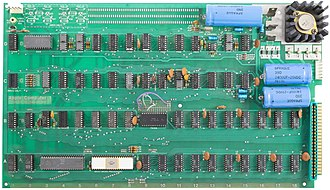
Trekked all over the San Francisco Bay Area to find buyers for the $500 machine which they called the Apple-1. The Apple-1 was large and unwieldy, Jobs realized they needed a new design for a computer that anyone could use. Wozniak began to build the Apple-2, the fate of Apple changed dramatically when in the fall of 1976, a visitor to Wozniak’s garage saw the prototype of the Apple-2, the visitor was Mike Markkula who at 32, had retired from Intel as a millionaire. He was so impressed by the Apple-2 that he joined Apple and put it on a sound business footing. The Apple-2 was introduced to the public and sales skyrocketed but in 1978 even with the success of the Apple 2, using a computer wasn’t easy. The early Apple computers as well as all early personal computers did not have graphical interfaces they didn’t have a mouse, they had what’s known as a command-line interface, that is you typed instructions into the computer and your instructions appeared as text on the screen.
A simple to use computer have been conceived by a computer scientist named Doug Engelbart, he demonstrated his vision in 1968 at the fall joint computer conference in San Francisco “I hit W and say delete work the air moves back and forth to give me feedback” wielding a keyboard and a pointing device he called a mouse angle. Bart worked with the computer 30 miles away linked by microwaves and demonstrated word processing and hypertext many in the audience went home inspired but one group alone was to fulfill angle Bart’s vision.
That group was just down the road, from San Francisco at Xerox PARC. In 1970, Xerox dominated the copier industry but thought the future might be in computers. A young Xerox executive Robert Taylor worked with a team to transform the way the computer industry was perceived as Robert Taylor himself remembers the chairman of Xerox at the time Peter McCulloch made a speech where he said that that Xerox was going to become the architecture of information.
Robert Taylor hired many of the country’s top computer scientists and challenged them to create an easy-to-use personal computer, the result was the Xerox Alto which incorporated many of the innovations in personal computers we take for granted today all developed at Xerox PARC. The alto used a mouse, a graphical interface, built in networking and printed on a laser printer.
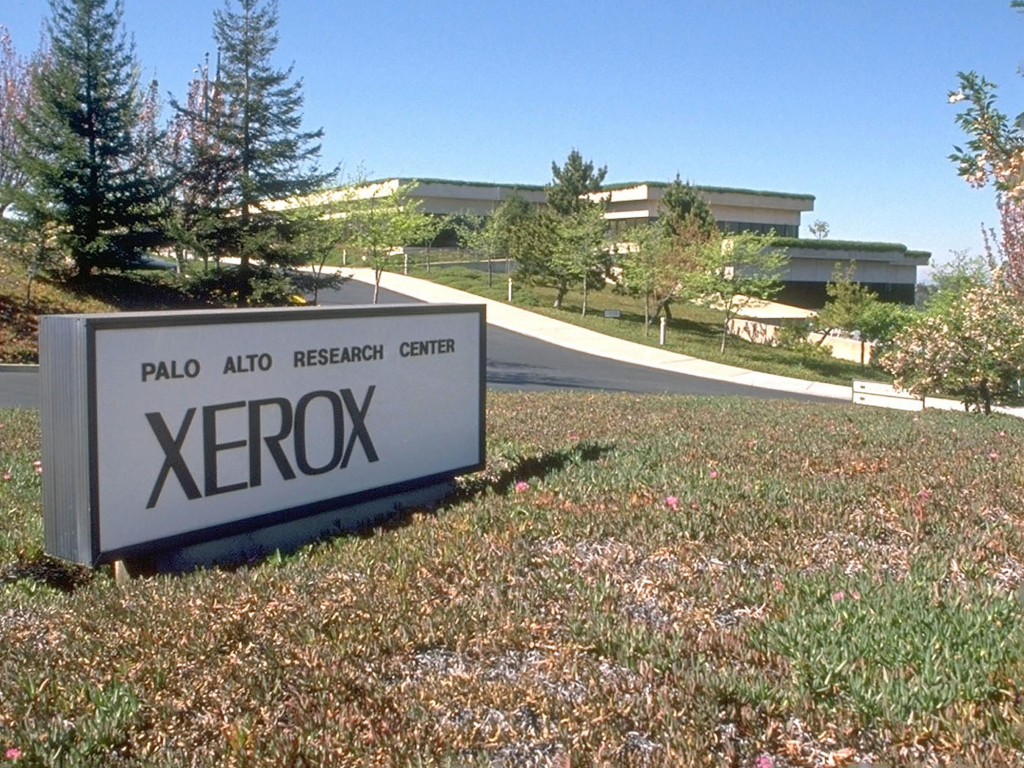
Xerox developed the star the commercial model of the alto but it never sold well. Xerox was a large and very successful photocopier company and it didn’t really understand computers, didn’t appreciate the brilliance, the originality, and the enormous commercial worth of the computer developments at Xerox PARC. But Steve Jobs did in 1979, Steve Jobs visited Xerox PARC and saw the alto he returned to Apple and immediately set to work on what would become the Macintosh computer, the first popular personal computer similar to those used today.
What made the Macintosh easy to use was its operating system and applications otherwise known as software, increasingly software was dominating the advances made in computers. Bill Gates the young president of computing software company Microsoft understood the importance of software to the future of computers and parlayed this vision into a vast software empire making him the richest man in the world. The dream of a machine that could think had come from a mechanical device to an electronic one where the bits of coded information that ran it were as important perhaps more important than the machine that they controlled, this may have been the best evidence that a thinking machine had arrived and could now be placed on your desk soon. Nearly half the jobs in America would use the computer within the decade, microprocessors would be everywhere, incorporated into automobiles appliances and scientific instruments significantly increasing their capability and reliability. Unprecedented fortunes were made in businesses that hadn’t existed a decade.
Education would be transformed forever as the access to information would be transferred from libraries and universities to your desktop, the earth would shrink with unprecedented speed as a worldwide communication grid became accessible to anyone with a computer and modem and even now the evolution of a thinking machine isn’t finished, computers have already changed the way we live and they’ll change the way we explore our world and other worlds in the 21st century they will take us to distant galaxies and they will connect us right here on earth. Computers will continue to become more interconnected they will continue to become smaller faster cheaper and software will become more powerful.
Minds that have yet to be formed will mold this power to create new marvels inconceivable to us today.!





 Not Rocket Science!
Leave a comment