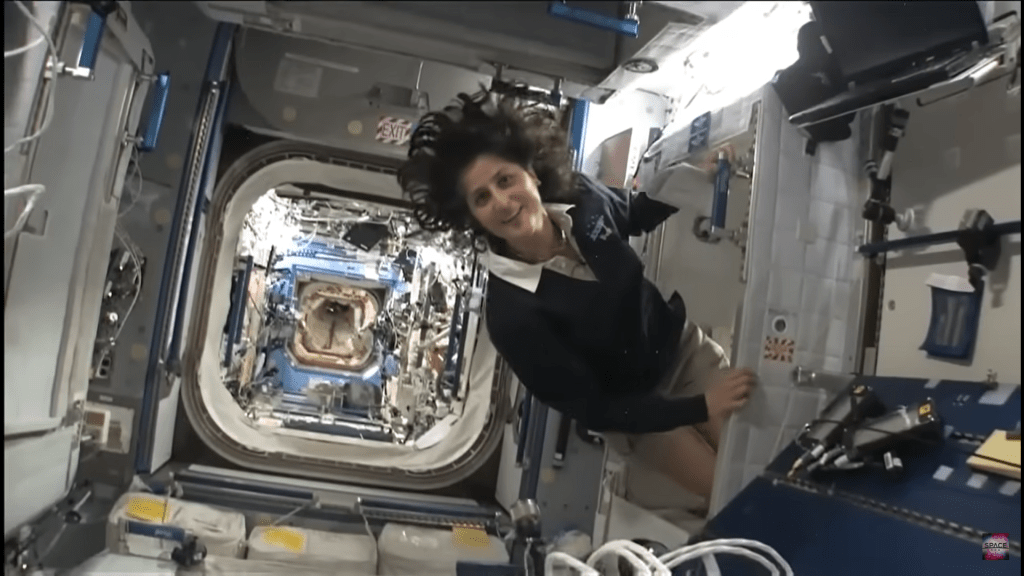
The featured image is from a YouTube video published by NASA 11 years ago, where Sunita Williams is giving a tour of International Space Station (ISS) and showing how astronauts go about doing there everyday business up in a confined space roughly 400 km up, the sky way!
Did I mention the speed at which this confined station travels? BTW, the confined space is ISS, so far humanities ONLY outpost up there. Side Note, NASA is bringing ISS down, well that is something for another day!
ISS is faster than you imagined.
Yes, where were we? Aha, that thought left us with a speed of 27,600 km/h1. Take a deep breath. Can you just imagine? Let that number sink in!
Just for reference, Usain bolt runs at 44 km/h2, the fastest production ready car, Bugatti Chiron Super Sport 300+, can barely manage 400 km/h3, and the commercial flights we take to fly on earth, travels with a speed on 950 km/h4. And this is debatable, but the one of the fastest jet to ever fly and documented is my personal favorite, Lockheed’s SR71, Blackbird! Well that jet was something, flying at a speed of a remarkable 3,529 km/h5. That is four times the speed we all will ever travel, possibly, until Elon makes space travel peanuts. But whom am I kidding, it is still a very long dream for majority of the people.
Source: VideoFromSpace, YouTube
Have you crunched your numbers by now? Allow me to help you here. Any astronaut at ISS is travelling, a banging, twenty-nine times faster than we could ever travel in our entire life. Next time your manager asks you to come office faster, ask him to bring ISS down to earth (well, that won’t solve the problem either, but, sleep early at night, might :p)
Clearly Astronauts Float, don’t they?
While enjoying the video and satisfying the curiosity of knowing the daily life in the space, one particular thing stuck with me. This one thing which is always taken so granted by all of us, the way astronauts move around the confined space, well for that matter, even outside the ISS. I called it “floating” for the largest duration of my life. It do “appear” to be floating. You stay at a definite location given no external force act on your body, very similar to the buoy exercise every beginner is asked to do after entering the swimming pool.
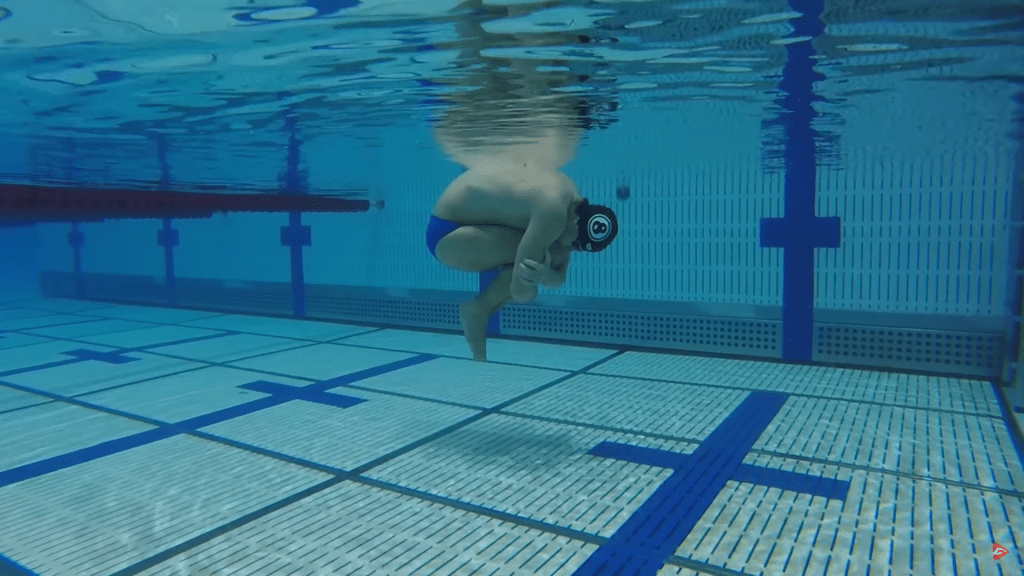
Source: SwimUp, YouTube6
Floating on water and floating in space should be similar, ain’t it? Well that is what we can see from the images here. But let’s be open to new ideas (or the correct ones :p)
Is Floating in Water and Space the same?
One question, “Why do we even float inside the water with air filled in our lungs?” Even if you haven’t taken any preliminary physics or science class, you understand the importance of air inside the lungs. For a living body, that is air from our lungs, but for a dead body, it is the collection of the gases released from decomposition process and gets trapped inside the body. Bottom line, some gases needs to be present, if not, you sink, eventually! Irrespective of whether you are an Olympian or anything.
But what does gas do to our body underwater? Simply put, gases are lighter than liquid (i.e. water in our case here), and if it lighter, it tends to rise underwater. Correct? Yes, it is correct, but is it the cause or the effect? Agreed, the density of the gas is lower than that of water which makes it lighter, so what? why does it have rise underwater?
Gases rise underwater, but why?
Here is a 27 seconds long video of bubbles rising underwater. Take a pause for those 27 seconds and just admire what is happening in the video. You will get the answer after watching it up close.
Source: Pixabay
You noticed it correctly, the bubbles do rise in the water. And I am saying it is effect, not the cause. Does this ring a bell? Would you like to watch it again and answer? If you have given it a decent effort, you would notice what is invisible to everyone in this footage, the water itself. If it was visible, then it would have been super easy.
So what I like to tell myself is NOT that the bubble rises underwater, but the surrounding water rushes down and occupy the location of the bubbles, causing the “effect” that bubble rises up. At the end of the day it is the same thing, but it makes a difference in our understanding, at least it makes a difference to me. Otherwise why would we be sharing such minute ideas time to time on NotRocketScience.
Now that we understand, why do bubbles rise underwater, we can answer why do a body filled with gas floats. Because the surrounding water wants to displace the gas from that volume, but the weight of the body is such that it doesn’t allow water to displace back to its original location. This constant reverse tug-of-war keeps the body floating.
Side Note: The weight of the body is caused by gravitational pull from the earth and the water trying to displace the occupied volume is called the buoyancy force. When these two forces balance, the body doesn’t experience any resultant force, and continues to do whatever it was doing. If it happens to be at rest, it stays at rest.
Food for thought, now that we know what happens inside the water, I want you to examine if this case is similar to the body in space? You might find the answer, and if you are able to think on your own, the purpose of this article is complete.
Till next time!
TL;DR.
Generated using AI.
- ISS Speed: The International Space Station (ISS) travels at an astonishing speed of 27,600 km/h, far exceeding any Earth-bound transportation.
- Speed Comparisons:
- Usain Bolt: Runs at 44 km/h.
- Bugatti Chiron Super Sport 300+: Reaches 400 km/h.
- Commercial Flights: Cruise at around 950 km/h.
- Lockheed SR-71 Blackbird: Flies at 3,529 km/h.
- Astronauts “Floating”: Astronauts appear to float in the ISS, similar to how we float in water, prompting questions about the nature of this phenomenon.
- Floating in Water vs. Space:
- In Water: Floating is due to buoyancy forces where the body’s weight is balanced by the upward force of displaced water.
- In Space: The article encourages readers to ponder whether the same principles apply or if different physics are at play.
- Invitation to Reflect: Readers are prompted to think about the differences between floating in water and floating in space, enhancing their understanding of basic physics principles.
References.
- NASA (2022) “International Space Station Facts and Figures”.
Accessed On: 12th November 2024 ↩︎ - BBC (2015), “Usain Bolt: Eight-time Olympic champion’s career in 9.58 charts“
Accessed On: 12th November 2024 ↩︎ - MotorBiscuit (2023), “These Are the Fastest Production Cars in the World Right Now“ Accessed On: 12th November 2024 ↩︎
- Encyclopaedia Britannic, “Jet aircraft“.
Accessed On: 12th November 2024 ↩︎ - MigFlug, “The fastest Plane in the World – SR-71 Blackbird“
Accessed On: 12th November 2024 ↩︎ - YouTube, SwimUp, “LEARN TO SWIM: TUTORIAL FOR BEGINNERS (THIS WORKS!)“
Accessed On: 12th November 2024 ↩︎






 Not Rocket Science!
Leave a comment