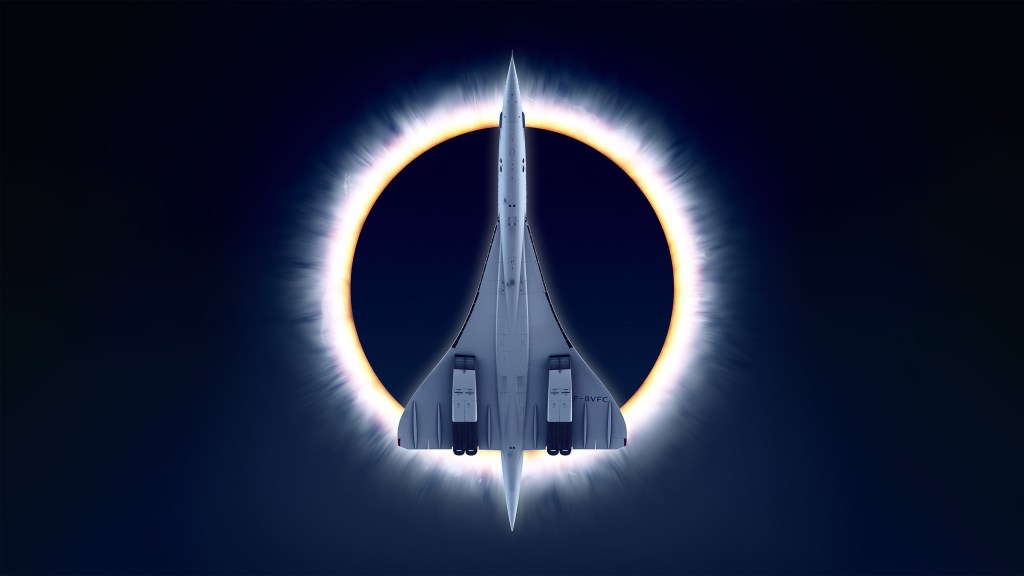
Imagine reaching New York from London in just a few hours—that’s what the Concorde promised. The Concorde captured the imagination of people around the world with its promise of supersonic travel.
Its sleek, needle-nose design and unmatched cruising speed of Mach 2.04 epitomized the “need for speed.” Yet, despite its groundbreaking achievements, it was retired in 2003, dashing the dreams of many. This unfortunate event was largely attributed to extreme aerodynamic heating that made the aircraft’s flight uncomfortable, even unbearable.
Why Does Aerodynamic Heating Occur?
Imagine you’re in a car, and you put your hand outside the window despite your parents’ nagging not to—you experience resistance from the air. Now, scale that up to an aircraft traveling at a speed greater than the speed of sound. The air resistance, or drag, is magnified a hundred times compared to the car. Startled by the higher speed, the air responds with a series of shock waves and regions of high pressure. These shock waves generate disturbances called entropy waves (the waves of disorder), which carry energy in the form of heat.
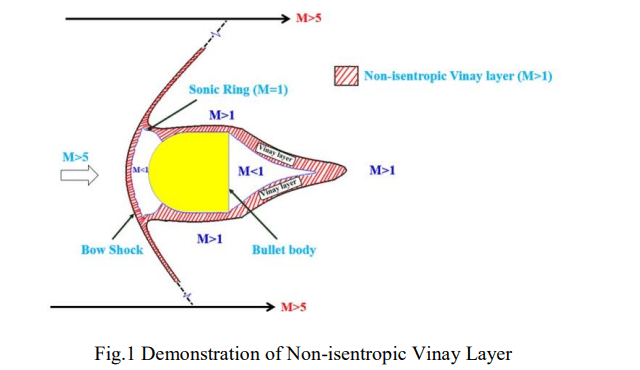
Simultaneously, when the aircraft travels faster than the speed of sound, a series of sonic points, where the speed equals the speed of sound, form around it. These points collectively create a layer known as the “sonic jacket.” The distance between the aircraft surface and this sonic jacket is called the “standoff distance.”
The problem: Entropy waves travel through the sonic jacket and contribute to aerodynamic heating—not good.
In a research paper by Vinal et al., the concept of the “Non-Isentropic Vinay Layer” was introduced. This layer is situated between the bow shock and the sonic jacket. The researchers suggested that by altering the standoff distance and the characteristics of this layer, the amount of heat transferred to the aircraft could be controlled.
Why Does This Matter?
Higher standoff distance = cooler flights = less aerodynamic heating = perfect.
The researchers also claimed that the standoff distance could be increased by introducing fluids with high heat capacity ratios.
With these breakthrough concepts of the sonic jacket, entropy layer, and Non-Isentropic Vinay Layer, the Concorde—or a new generation of supersonic aircraft—could soar through the skies again, safer this time.
May the control of aerodynamic heating be with you!
Reference: Dekkala Vinay, Raunak Sharma, and V.R.Sanal Kumar, “Let the Concorde Fly Again: Higher Standoff Distance of Sonic Jacket Reduces Aerodynamic Heating”, https://doi.org/10.2514/6.2023-76897











 Not Rocket Science!
Leave a comment