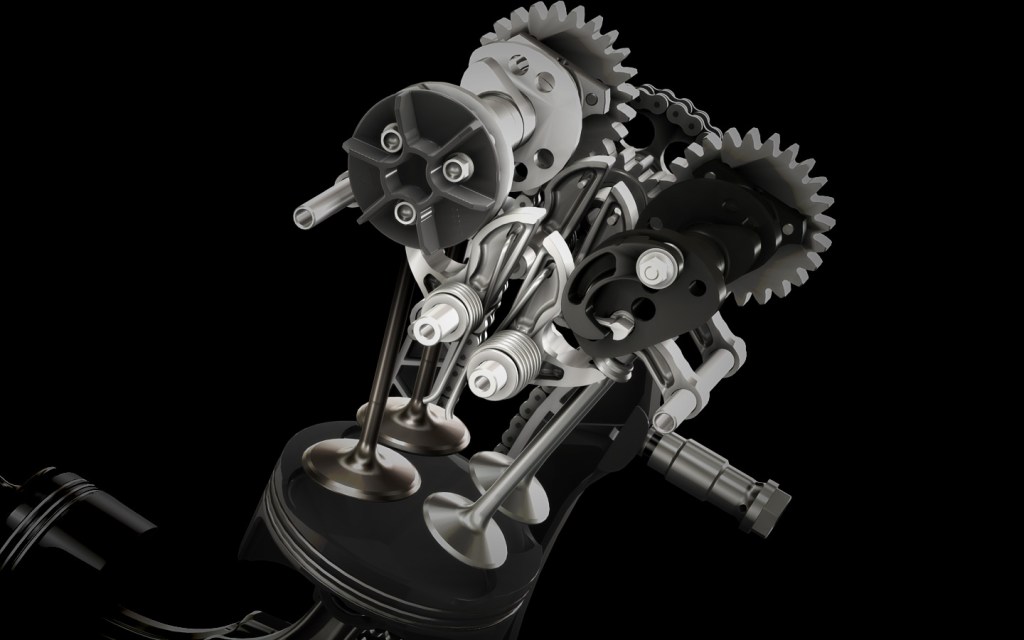
Have you ever heard of this word “Desmo” or “Desmodromic”? If you already have you probably know more than me already, because “Desmo” is seldom used in reference other than that of the Ducati. If that is NOT the case, then lets jump into this directly.
Quick Revision.
From the last article, we have understood the fundamentals of a four-stroke Internal Combustion Engine, the components which composes it and the importance of synchronizing everything perfectly! That is where the problem faced while having a conventional spring based poppet valve retraction pops up. At higher reciprocation of the piston inside the cylinder bore, the lag from the spring doesn’t allow the valve to close properly, jeopardizing the combustion inside, this is what we called “valve float” business.
You may wonder, if floating is a problem, then put a stronger spring to push back poppet valve with more force, right? WRONG, for two reasons.
Firstly, remember the cam shaft controlling the valves are themselves powered by the crankshaft which in turn is powered by the combustion taking place in the cylinder head. Making a stiffer spring would keep the spring stiff for the entire range of the engine operations, and why is that a problem? Because it steals the energy of the combustion when it is not even needed in the low to high engine speed range.
Secondly, making a lighter yet stiffer spring was NOT possible owing to the limited research in Metallurgy in that period. Inevitably, this demanded the superbike manufacturers to put an upper limit on the RPM offered by the engine. And did that stop the researchers at Ducati? Hell NO!
The Birth of Desmodromic Valves.
So, we get the problem, you can’t let the engine run at higher speeds, so just don’t do it and you will be fine, right?! Well technically, you are RIGHT. But if one believes in…
“racing on Sunday, selling on Monday”
– Giuseppe Montano, General Manager, Ducati
…it will be super difficult for them to accept the offered solution. The entire sales and thus the revenue of the company depends on the outcome of the leadership board of the Grand Prix. So limiting the engine from reaching such high engine speeds is NOT an option if you want to win the races on Sunday!
That is when the great Fabio Taglioni stole the thunder, and in 1956, decided to sidestep the valve-spring problem altogether by removing the problematic element, the spring itself! Like Whaaaaaaat?! Crazy People! I will NOT be able to explain the thought process behind this, other than the creator himself. Presenting Mr. Taglioni’s own words…
“The specific purpose of the desmodromic system is to force the valves to comply with the timing diagram as consistently as possible. In this way, any lost energy is negligible, the performance curves are more uniform and dependability is better.”
– Fabio Taglioni, Lead Engineer, Ducati

And how does this magic of Ducati delivers what is promises? It simply avoids the spring and replaces that with another cam which pushes it up for retraction instead of relying on the restoration energy stored inside the spring in the form of potential energy! And how does that even look? Tadaa!
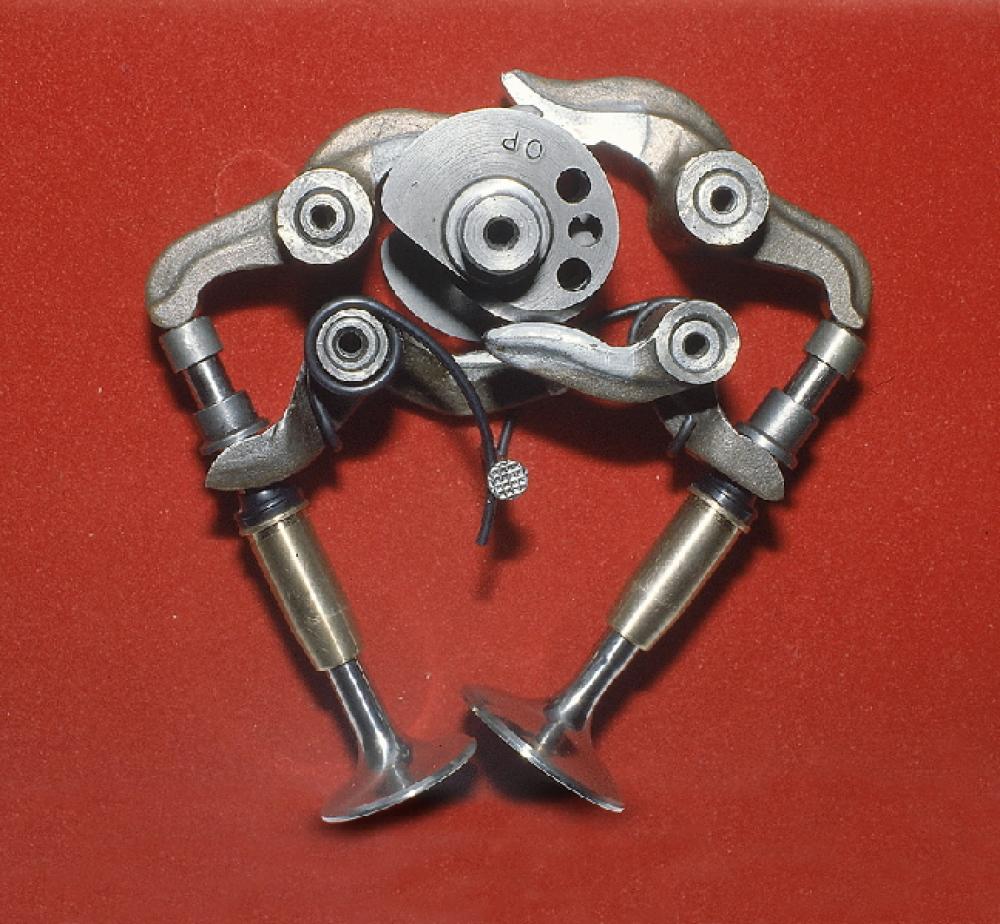
Source: MotorValley
When I found this image, I was struck! A beautiful image with such clear representation is just something I couldn’t hold back and had to use here.
Maybe, NOT the Birth of Desmo.
While in today’s time whoever knows Desmodromic Valves, they know it from Ducati and Ducati Only, including me as well till yesterday. While reading up a lot of documents on the same, I realized Ducati was NOT the first company to use Desmodromic valves in their engine. The references tell Norton Motorcycles and Mercedes also tried out Desmo in their cars. But it ONLY Ducati which popularized it by mastering it to the perfection and matured the technology to be mass producible.
So, YES! Maybe it was NOT the birth of Desmo at Ducati, but definitely it was nothing less than a REBIRTH as well.
The Success.
By leveraging desmodromic valve technology, Ducati achieved significant success in racing immediately which confirmed the technology and boosted the sales, and further establishing a reputation for engineering excellence in its production motorcycles.
Ducati has consistently refined its desmodromic system, integrating advanced materials and engineering techniques to enhance performance and reliability. Insights gained from racing applications have been applied to consumer models, allowing Ducati to offer high-performance motorcycles that benefit from race-proven technology.
In that era, practically every bike out of the factory had Desmo valves for timing. Though this is NOT the case anymore, which perfectly sets the stage for the next section.
The Failure.
Though the Desmo offered amazing benefits for that time, the new motorcycles of “mid-capacity” Ducati are configured with conventional spring based timings system.
And how did this happen? Only one way to find out, stay curious for the next article.
TL;DR.
Generated using AI
- Concept Clarification: “Desmo” or “Desmodromic” refers specifically to a unique valve mechanism used predominantly by Ducati, not commonly associated with other brands.
- Problem with Traditional Valves: Standard spring-based valves can suffer from “valve float” at high RPMs, where the valve fails to close properly, compromising engine efficiency.
- Ducati’s Innovative Solution: In 1956, Ducati engineer Fabio Taglioni developed the desmodromic system, which uses cams instead of springs to close the valves, enhancing reliability and performance at high speeds.
- System Advantages: This technology ensures precise valve timing, reducing energy loss and improving engine performance and dependability.
- Historical Context: Though not the first to use desmodromic valves (Norton and Mercedes experimented with them), Ducati perfected and popularized this technology in motorcycles.
- Impact on Racing and Sales: The adoption of desmodromic valves significantly boosted Ducati’s success in racing, which translated into increased sales and a strong reputation for engineering excellence.
- Modern Application: Despite its past benefits, newer mid-capacity Ducati models have returned to conventional valve systems, setting the stage for future innovations.











 Not Rocket Science!
Leave a comment